8 October 2026
Double Tax Treaties in France
How foreign investors can avoid double taxation in France, due to the double tax treaties signed by France and other countries.
France is one of the most appealing countries for foreign investors all over the world, which is why having treaties and conventions which offer advantages to those setting up companies in France or working here has always been a priority of the French government. Among the most important agreements signed by France are those related to the avoidance of double taxation.
At the moment, France has signed more than 100 double taxation treaties with countries all over the world.
You can read below on the main advantages offered by France’s double taxation agreement. You can rely on our company formation specialists in France for information on how to benefit from various double tax treaties. We can also help open a company in France.
Double taxation treaties signed by France over time
France is one of the countries which have signed most of the double tax treaties around the world.
The treaty countries and jurisdictions are: Albania, Algeria, Argentina, Armenia, Austria, Australia, Azerbaijan, Bahrain, Bangladesh, Belarus, Belgium, Benin, Bolivia, Bosnia and Herzegovina, Botswana, Brazil, Bulgaria, Burkina Faso, Cameroon, Canada, Central African Republic, Chile, China, Congo, Croatia, Comoro Islands, Cyprus, Czech Republic, Denmark, Ecuador, Egypt, Estonia, Ethiopia, Finland, French Polynesia, Gabon, Georgia, Germany, Ghana, Greece, Guinea, Hungary, Iceland, India, Indonesia, Iran, Ireland, Israel, Italy, Ivory Coast, Jamaica, Japan, Jordan, Kazakhstan, Korea Republic, Kuwait, Kyrgyzstan, Latvia, Lebanon, Lithuania, Luxembourg, North Macedonia, Madagascar, Malawi, Malaysia, Mali, Malta, Mauritania, Mauritius, Mexico, Moldova, Monaco, Mongolia, Montenegro, Morocco, Namibia, Netherlands, New Caledonia, New Zealand,, Niger, Nigeria, Norway, Oman, Pakistan, Philippines, Poland, Portugal, Qatar, Romania, Russia (most provisions suspended since 8 August 2023), St. Pierre, Saudi Arabia, Senegal, Serbia, Singapore, Slovakia, Slovenia, South Africa, Spain, Sri Lanka, Sweden, Switzerland, Tajikistan, Thailand, Togo, Trinidad and Tobago, Tunisia, Turkey, Turkmenistan, Ukraine, United Arab Emirates, United Kingdom, United States of America, Uzbekistan, Venezuela, Vietnam, Zambia, Zimbabwe.
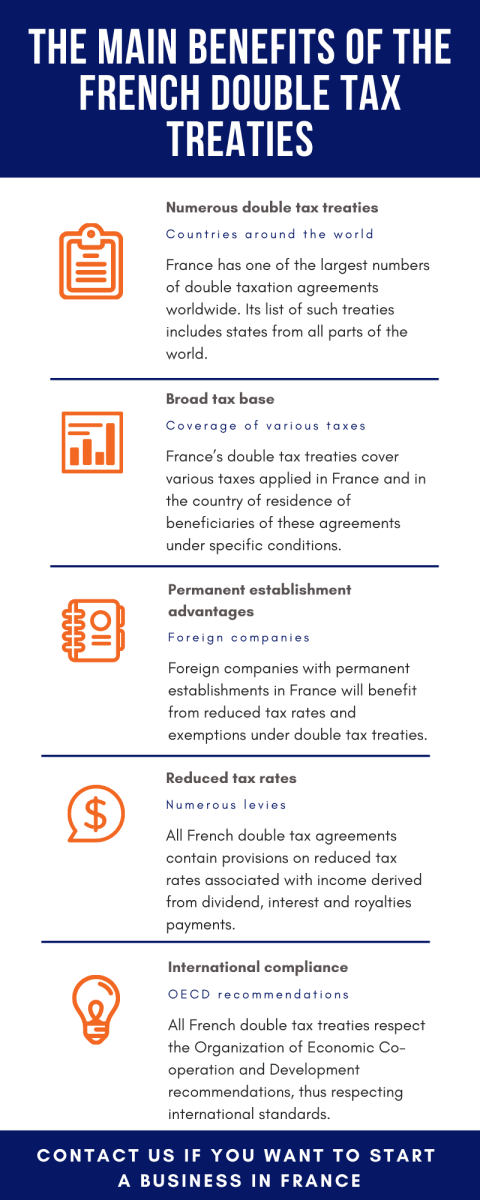
You can find out some of the main advanatages of France’s double tax treaties from the infographic below:

What are the taxes covered by French double tax treaties?
Each tax agreement has its own characteristics, because France has negotiated each agreement in particular. However, France follows the Organization for Economic Co-operation and Development (OECD) recommendations when it comes to its double tax treaties and has included various similar conditions in each convention.
One of these conditions refers to the taxes covered by the agreement in France and the other signatory country. As a general rule, the following taxes are covered by France’s double tax treaties:
- the income tax which applies France and the other country under different forms;
- the corporate tax – companies are some of the most important beneficiaries of double taxation treaties;
- the taxes on salaries which are levied in France are also contained in its double tax treaties;
- the capital gains tax is also subject to the provisions of French double taxation conventions;
- France also imposes a social contribution on companies which is subject to the provisions of its agreements for the avoidance of double taxation;
- all agreements signed by France contain a clause which refers to other similar taxes imposed in both signatory countries and which are covered by the treaties.
If you need information on the corporate taxes applied in France, our local specialists can advise you.
Permanent establishments under French double tax agreements
According to most France’s conventions for the avoidance of double taxation, companies in signatory countries have the right to set up operations under different forms in France. Under the provisions of double taxation treaties these are called permanent establishments and are treated preferentially by being taxed only on the income they generate here.
The permanent establishment status can be granted to a branch office, a factory, a management place or even a mine, quarry or other place for the extraction of natural resources. In order to be deemed a permanent establishment, such place must carry out its activity for a specific period of time during a calendar year.
If you want to set up a permanent establishment and need support, our French company formation advisors can help you. They can also explain the benefits you can obtain for such an establishment under a double tax treaty with France.
Taxation of income under France’s double tax conventions
When referring to the taxation of income under one of France’s double taxation treaties, the following aspects need to be considered:
- – if the respective income is taxable in France;
- – if the respective income is exempt from taxation in France;
- – if the said income must be declared in France;
- – what provisions of the double tax treaty in your country apply in order to avoid double taxation.
If the income is taxable in France, the double taxation agreement must contain provisions with respect to the way in which double taxation is avoided. France uses two double taxation elimination methods: the exemption method (income taxed abroad is exempt in France, often with progression) and the tax credit method, under which the foreign tax is credited against the tax due in the home country.
For complete information on how double taxation is avoided in France, you can talk to our company registration consultants in France.
Changes to the agreements
Besides the already signed treaties, France has many other drafts prepared for signature.
The above agreements are often revised in order to bring new and actual changes that would match the economic environment nowadays. Revised DTA were signed with Saudi Arabia, Austria and Mauritius in 2012.
As a general rule, the double tax treaties are dealing with the taxation of capital and income in France for a non-resident investor. The double tax treaties deal with earned income, passive income and gains from real property.
Advantages for the foreign investors
The incomes of a company established in France are taxed in France even if its shareholders reside in a treaty country; treaties mainly reduce withholding tax on distributions to them. Dividends received are then also taxable in the investor’s country of residence.
The passive income, such as dividends, interest and royalties are usually subject to a withhold tax, usually smaller than the tax applicable to non-treaty countries, with a rate ranging 0%-15%.
The taxation of real property is made in France, but certain special incentives may be stipulated in every signed treaty.
Along with the treaties, protocols of exchange of information regarding the taxpayers are signed in order to avoid the tax fraud in France and in the country of residence.
Why open a company in France?
France attracts many investors from abroad thanks to its thriving economy. According to INSEE, the Banque de France and EY, France:
- – registered GDP growth of 0.8% in 2025, after 1.5% in 2024;
- – compared to last year, growth is projected at 0.4% in 2026 and 0.9% in 2027 (Banque de France, September 2026);
- – unemployment stood at 8.3% in Q2 2026 (INSEE);
- – France is one of the most appealing investment destinations in Europe, ranking first in Europe for foreign investment projects for the seventh consecutive year in 2025 (852 projects, EY Attractiveness Survey 2026).
For more information about avoiding double taxation, you may contact our agents in company formation who will help you open a company in France.